


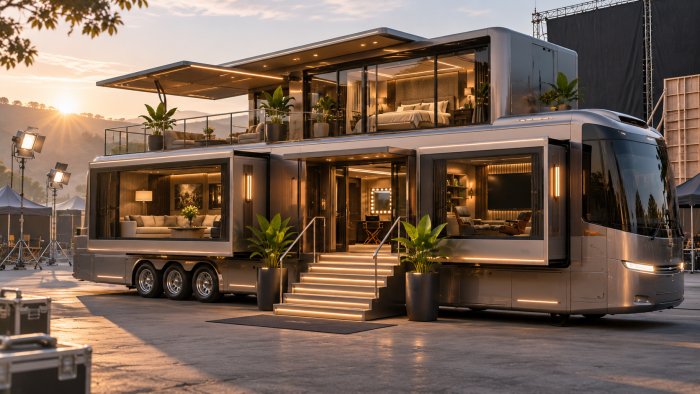
Cover image: AI-generated concept illustration, not a photograph of Will Smith’s trailer or an Anderson Mobile Estates vehicle.
The word trailer usually suggests the practical edge of a film set: a temporary place to wait, change or prepare. A two-story mobile estate turns that familiar image into something closer to a piece of traveling architecture. Will Smith’s connection with Anderson Mobile Estates is a useful starting point for exploring this unusual corner of entertainment design, without pretending that an online room tour is a personal visit.
What the builder confirms
Anderson Mobile Estates’ own history describes the family’s earlier business, Star Trax Celebrity Coaches, founded in 1987. After selling that business, the family developed the idea of a two-story expanding trailer with yacht-inspired comfort. The company says its prototype became The Studio Mobile Estate and was later sold to Will Smith. That establishes a direct connection between the actor and the builder’s early development, rather than relying entirely on repeated celebrity-home headlines. Read the builder’s history.
The wording matters. The manufacturer’s current collection lists both The Studio and The Heat. Without additional documentation tying every published photograph and specification to the same vehicle and period, those labels should not simply be merged into one definitive room-by-room account. See the collection.
The interesting idea is the transformation
An expandable trailer asks a different design question from an ordinary house. It must exist in a transport configuration and in a larger usable configuration. That contrast gives the subject its visual appeal: what looks like a vehicle belongs, once set up, to the language of rooms and interiors.
For a viewer, the most revealing question is how the space changes, not how many expensive finishes a headline can count. Where does a circulation route appear? How are shared and private areas separated? Which features help the space function, and which are there mainly to impress? These are ways to read a design, not claims about a particular undocumented floor plan.
More than celebrity decoration
The builder describes a customization process involving interior materials and audiovisual equipment, and its website also presents work for corporate clients. The broader category therefore extends beyond an actor’s luxurious retreat. It brings interior design to locations where a conventional building is not the starting point. Explore the manufacturer’s overview.
That is the useful behind-the-scenes perspective. A film’s finished images conceal much of the infrastructure around their production. A mobile estate makes one part of that surrounding world visible, even if the most extravagant examples are not representative of everyday film work.
Enjoy the spectacle without inventing the details
A reported purchase price is not a current valuation, and an old rental story is not proof of present availability. Neither is needed to appreciate the concept. The documented origin already contains a compelling story: a coach-building family pursued an expandable two-story design, and an early example reached a major film star. The fascination lies in the collision of mobility and domestic comfort, not in repeating every number attached to it.